
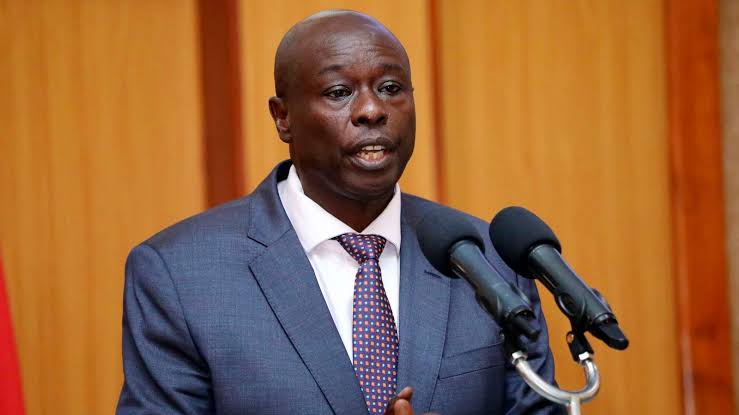
Former Deputy President Rigathi Gachagua has escalated his criticism of the Independent Electoral and Boundaries Commission (IEBC), linking recent staff transfers to a disputed tender for the technology expected to support Kenya’s 2027 General Election.
Gachagua, the leader of the Democracy for Citizens Party, alleges that IEBC officials were moved after refusing to defend tender specifications that he claims were designed to favour South Korean technology company Miru Systems.
He said officials in the commission’s Supply Chain Management and Electoral Management directorates had been pressured to support the specifications in proceedings before the Public Procurement Administrative Review Board (PPARB).
Gachagua further alleged that those who refused were subsequently transferred from IEBC headquarters to county stations.

“The Chairman and his Vice Chair have victimised officials in the two departments and transferred all of them, except the compromised head of department, to far-flung counties,” he said.
The transfers are confirmed, but the motive is not
An IEBC memo dated August 12 confirms that a number of staff were transferred or redesignated, with affected officers instructed to report to their new stations by August 17.
The changes involved officials in several departments, including Supply Chain Management and electoral operations. However, the memo does not state that the transfers were connected to the Miru tender or that they were disciplinary measures.
That distinction is important. The existence of the transfers does not, on its own, establish Gachagua’s claim that they were retaliation for opposing the procurement.
Tender already facing legal challenge
The controversy centres on IEBC’s planned Integrated Elections Management System (IEMS), which is intended to support functions including voter registration, voter identification and verification, candidate registration and transmission of election results.
IEBC advertised the tender on August 11. The procurement has since been challenged by Galadirel Investment Limited before the PPARB, which has temporarily halted proceedings pending determination of the dispute.
The company has raised concerns about aspects of the tender, including the technical specifications and the undisclosed contract value despite a requirement for bidders to provide Sh30 million in tender security.
IEBC has denied that the tender was designed for a particular company.
The commission has, however, acknowledged one error in the tender documents. It mistakenly required successful bidders to provide performance security equivalent to 20 per cent of the contract price, despite the legal ceiling being 10 per cent. IEBC said it was preparing an addendum to correct the mistake.
Gachagua wants the tender cancelled
Gachagua has called on IEBC to abandon the procurement and instead upgrade the existing system.
He argues that introducing a new election management system less than a year before the August 10, 2027 General Election could create unnecessary risks, particularly around migration and protection of the voters’ register.
“It is not technically possible to procure a new election management system given that the elections are 11 months away,” Gachagua said, citing what he described as advice from procurement experts and IEBC insiders.
He has also urged the PPARB to cancel the tender when it determines the challenge.
IEBC faces pressure to prove the process is open
The commission, meanwhile, maintains that the procurement is still a competitive process and has rejected claims that Miru Systems has already been selected.
No evidence has been publicly established that Miru has been awarded the contract.
The immediate question is now whether the procurement will survive the PPARB challenge, whether IEBC will amend the tender and whether the commission can complete the process, test the new technology and deploy it in time for the 2027 election.
For IEBC, the stakes extend beyond the technology itself. Any new system will have to work under intense scrutiny while convincing political parties, election observers and voters that the process is transparent and that the integrity of the voters’ register and results is protected.
With the 2027 election less than a year away, the procurement dispute is becoming an early test of public confidence in the systems that will underpin the next presidential and parliamentary vote.
Related Stories
- Oburu Oginga hospitalised as family weighs UK treatment
- KAWU calls off aviation strike after government deal
- Ruto Joins African Leaders for Hichilema’s Second Inauguration
Category: News · Related Topic: 2027 Elections
Related Video: Gachagua’s explosive Ruto scorecard: Debt, taxes, State capture and a government ‘that has failed’
Related Explainer: EXPLAINER: Why Kenya’s aviation workers are striking — and what travellers need to know
About the Author
Maureen Onyango is a journalist passionate about storytelling, life coaching and spiritual lessons. She studied at the Kenya Institute of Management and enjoys telling stories that inform, inspire and empower communities.
 Facebook
 Twitter / X
 WhatsApp
 LinkedIn
 Telegram
 Reddit