
Nepal’s worst flood disaster in years has killed more than 1,000 people, with thousands still missing as rescuers battle mud and debris to reach hydropower tunnels.
Nepal has recovered 1,010 bodies after catastrophic floods and landslides swept through the Himalayan country, with about 4,000 people still unaccounted for, according to the government’s latest update on Tuesday.
More than 11,800 people have been rescued, but the search remains desperate in areas where hydropower workers are believed to be trapped underground.
The floods struck on August 26 after a glacier collapse triggered a massive surge of water, rocks and debris along the Bhote Koshi and Trishuli river systems near the Nepal-China border.

Race against time underground
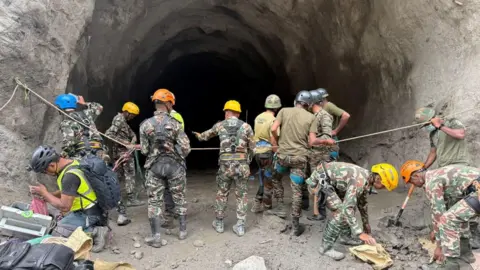
Hundreds of workers remain missing from hydropower projects in some of the worst-hit areas. Around 500 are believed to be trapped inside tunnels buried by mud and debris.
Rescuers are using specialised equipment and international expertise to reach them. Nepal has received assistance from India, China and South Korea, while other partners are providing technical support.
The operation is extremely difficult. Some tunnels have been filled almost completely with mud, leaving rescuers with little room to search.
At least 21,000 members of Nepal’s security forces are now involved in search, rescue and relief operations, according to the government.
Families are still waiting for news of loved ones who went to work at the hydropower sites and never returned.
International response grows
South Korea announced Tuesday that it will send a 44-member emergency relief team to Nepal following a request from Kathmandu. The team includes personnel from the foreign ministry and fire service and will assist with search and rescue operations.
Nepal has also called for specialist assistance in areas including tunnel rescue, DNA identification, forensic work and equipment such as LiDAR technology.
The disaster has also created a major challenge in identifying victims. Authorities say DNA samples are being collected from unidentified remains, with temporary burials used where bodies cannot be safely preserved.
Climate warning
The disaster has renewed concern over the growing risks facing communities and infrastructure in the Himalayas.
A glacier collapse triggered the flooding, although scientists are still examining the precise causes and the role of climate change. Research has already shown rapid ice loss across the Hindu Kush Himalayas, increasing concern about the stability of high-mountain environments.
Prime Minister Balendra Shah has called for greater international attention to climate-related disasters affecting the Himalayan region.
For now, however, the priority remains the search.
Every hour matters for families waiting to learn whether their relatives are alive, trapped underground or among the thousands still missing.
You may also like
Category: International
Related Explainer: Fact Check: Did elephants save people during Nepal’s floods?
About the Author
Maureen Onyango is a journalist passionate about storytelling, life coaching and spiritual lessons. She studied at the Kenya Institute of Management and enjoys telling stories that inform, inspire and empower communities.
 Facebook
 Twitter / X
 WhatsApp
 LinkedIn
 Telegram
 Reddit