
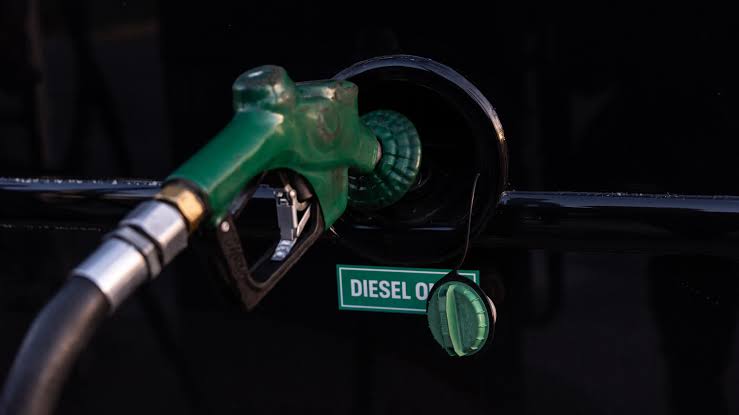
American drivers are paying more for diesel than ever before, with the national average climbing to a record $5.85 a gallon as the prolonged US-Iran conflict continues to disrupt global energy markets.
The latest figure, recorded by the American Automobile Association (AAA) on September 4, overtook the previous US diesel record of $5.8159, set in June 2022 after Russia's invasion of Ukraine.
The increase is being felt far beyond filling stations.
Diesel powers much of the machinery that keeps the US economy moving, including heavy trucks, buses, trains, farm equipment, construction machinery and some boats.

When diesel becomes more expensive, transporting food, manufactured goods and other essentials also becomes more costly.
That creates a risk that the pain at the pump will eventually show up in supermarket prices and household budgets.
Diesel has jumped more than 50% in a year
The latest AAA figure is about 58 per cent higher than the $3.71 average recorded a year ago.
Reuters reported that US diesel prices had risen about 55 per cent since the US-Israel conflict with Iran began in February, with tight global supplies and refinery disruptions adding to the pressure.
The squeeze is not simply about crude oil.
Diesel is a refined petroleum product, so disruptions at refineries can have a direct effect even when crude supplies remain available.
Reuters reported that the US diesel market is facing particularly tight inventories. East Coast stockpiles have fallen to levels that leave the region vulnerable to further supply disruptions.
Refiners have increased production, but that has not been enough to fully offset the loss of supplies from overseas markets.
The pressure could become even greater as demand for heating fuel rises heading into winter.
Hormuz remains the market's biggest worry
A major source of uncertainty is the Strait of Hormuz, the narrow waterway between Iran and Oman through which a significant share of the world's oil and liquefied natural gas normally passes.
The conflict has sharply reduced shipping through the route.
Reuters reported on Friday that only four commodity vessels crossed the strait on Thursday, compared with a 10-day average of about 15. The figures exclude vessels that had switched off their tracking systems.
Before the conflict, the strait handled around 125 commercial vessels a day.
The disruption has therefore created a problem that reaches well beyond the Middle East.
Even countries that do not import oil directly through Hormuz can feel the effects because crude and refined fuel are traded on a global market.
Oil prices have responded accordingly.
Brent crude and US West Texas Intermediate have risen sharply this week as fighting and threats to shipping have renewed fears of prolonged supply disruption.
Russia is adding to the diesel squeeze
The US is also facing another supply problem.
Ukrainian attacks on Russian refineries have disrupted facilities that play an important role in global diesel exports, adding pressure to an already tight market, according to Reuters.
That combination matters.
The US is dealing with higher crude prices, weaker international fuel flows and tighter diesel inventories at the same time.
The result is a particularly painful squeeze for a fuel that is central to freight and industry.
Trump's Venezuela plan faces a reality check
President Donald Trump has responded to rising energy costs by pointing to a new oil arrangement with Venezuela.
The agreement involves plans to develop 17 Venezuelan oilfields, with about 65 billion barrels of proven reserves associated with the fields, according to details reported by Reuters.
The plan is intended to increase oil production and strengthen US access to Venezuelan crude.
But it is unlikely to bring immediate relief to American motorists.
Venezuela's oil industry has suffered from years of underinvestment, ageing infrastructure and operational problems.
Reuters reported that Venezuelan production is currently around 1.25 million barrels per day, far below the roughly three million barrels per day produced at its peak in the late 1990s.
There are also questions over the structure and transparency of the new US-Venezuela arrangement.
Reuters reported that legal and industry experts have raised concerns about the deal's terms, including the lack of competitive bidding and uncertainty over its implementation.
That does not mean Venezuela cannot eventually provide more oil.
It means the additional barrels Trump is promising cannot simply appear at US petrol stations overnight.
A political problem for Trump
The fuel shock is also arriving at an awkward time for the White House.
Americans are heading towards the November midterm elections with household costs already a major political issue.
A Reuters/Ipsos poll published in August put Trump's approval rating at 33 per cent, its lowest level of his presidency at the time.
Only about 31 per cent of Americans approved of his handling of the conflict with Iran, according to the polling reported by Reuters.
Fuel prices are particularly politically sensitive because motorists see them every time they fill their tanks.
But diesel's economic impact can be even broader.
A truck driver pays more to fill a tank.
A transport company then faces higher operating costs.
Those costs can eventually be passed on to businesses and consumers.
Farmers and construction companies can face the same pressure.
Not every American is paying the same price
The national average also hides significant differences between states.
AAA's latest data shows diesel prices varying widely across the country.
California, for example, was averaging more than $7.70 a gallon, while prices in some other states were considerably lower.
Taxes, refining capacity, transport costs and the distance fuel has to travel all contribute to the differences.
That means the record national figure does not describe every driver's experience.
But the direction is unmistakable.
AAA's September 4 data puts diesel at $5.85 a gallon nationally, compared with just $3.71 a year earlier.
Petrol prices are rising too
Diesel is not the only fuel under pressure.
The AAA national average for regular petrol stood at about $4.15 a gallon on September 4, compared with roughly $3.20 a year earlier.
That is still below the all-time US petrol record of $5.0165 set in June 2022.
The difference is important.
Diesel has now broken its previous record.
Petrol has not.
But both are moving in the wrong direction for American households.
The bigger worry is how long the squeeze lasts
The record diesel price is a warning about more than what Americans are paying at the pump today.
The bigger concern is duration.
If the conflict continues to restrict shipping through Hormuz, while refinery disruptions persist in Russia and other producing regions, fuel markets could remain under pressure.
Reuters reported that analysts expect the disruption around Hormuz to remain significant, with some forecasting continued low shipping activity into November.
That would keep pressure on diesel supplies at precisely the time when US demand traditionally begins to rise ahead of winter.
For the White House, the challenge is therefore much bigger than promising cheaper petrol.
The administration needs global fuel supplies to stabilise.
The Venezuela deal may eventually add production, but it cannot quickly replace barrels disrupted by today's geopolitical crisis.
And for American households and businesses, that leaves an uncomfortable reality.
The diesel record has been broken — and the forces pushing prices higher have not yet gone away.
You may also like
Category: International
Related Video: Human Ladder Reaches Dangerous Heights as Climbers Keep Going
Related Explainer: Kenya’s inflation holds near 30-month high as transport and food costs squeeze households
About the Author
Maureen Onyango is a journalist passionate about storytelling, life coaching and spiritual lessons. She studied at the Kenya Institute of Management and enjoys telling stories that inform, inspire and empower communities.
 Facebook
 Twitter / X
 WhatsApp
 LinkedIn
 Telegram
 Reddit