
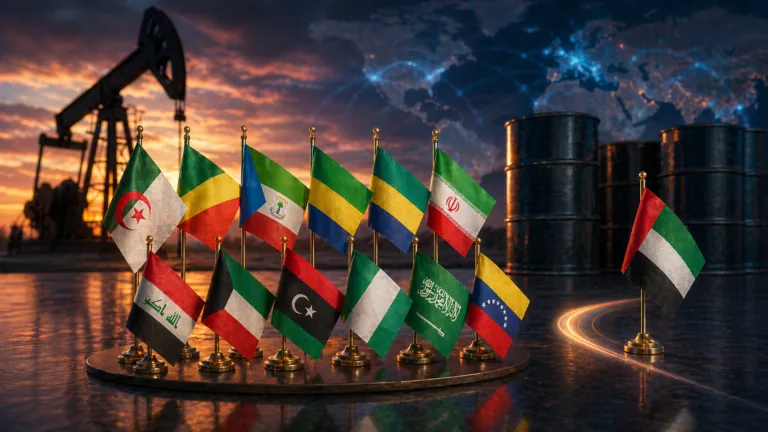
OPEC+ is expected to keep its oil production policy unchanged when key members meet on Sunday, even as the Iran war continues to disrupt supplies and keep global energy markets under pressure.
Three sources familiar with the discussions told Reuters that the group is unlikely to announce another change in production policy for October.
The decision would come after months of gradual increases in production quotas by seven core members — Saudi Arabia, Russia, Iraq, Kuwait, Algeria, Kazakhstan and Oman.
Those countries agreed last month to increase September production quotas by about 188,000 barrels per day, completing the phased reversal of 1.65 million barrels per day in voluntary cuts introduced in 2023.

But there is a major problem: increasing production quotas on paper does not necessarily mean more oil is reaching the global market.
Wars involving Iran and Ukraine have disrupted exports from the Gulf, Russia and Kazakhstan, leaving actual production below planned increases.
Iran war changes the oil equation
The Strait of Hormuz remains at the centre of uncertainty facing global energy markets.
The strategic waterway has historically carried roughly a fifth of global oil and gas supplies, making any sustained disruption capable of affecting fuel prices around the world.
The International Energy Agency said in its August oil market report that the continued closure of the Strait of Hormuz and renewed hostilities had significantly affected global supplies.
According to the IEA, global oil supply reached 101.5 million barrels per day in July but remained 6.3 million barrels per day below the level recorded a year earlier.
About 8.3 million barrels per day of Gulf production remained shut in.
The agency also said global oil inventories fell sharply in July as disruption to Gulf and Caspian exports reduced the amount of crude available to the market.
Oil prices remain volatile
The geopolitical uncertainty has resulted in unusually volatile oil prices.
The IEA said benchmark crude prices traded within a range of almost $40 per barrel during July as markets reacted to developments in the Iran conflict.
Prices climbed as high as $105 a barrel on July 23 after renewed hostilities undermined expectations of a recovery in Gulf oil supplies.
This means OPEC+ now finds itself in an unusual position.
Historically, the group's decisions to increase or reduce production have been among the biggest influences on global oil prices.
But war-related disruptions are increasingly determining how much oil actually reaches the market.
OPEC+ could therefore maintain or even increase production quotas without necessarily producing the corresponding increase in global supply.
Why Kenya should pay attention
For Kenya, developments in the Middle East are more than a distant geopolitical story.
The country imports virtually all the petroleum products required to power vehicles, industries and other parts of the economy.
Higher international oil prices can therefore increase the cost of importing fuel.
Those costs can eventually feed through to pump prices, transport fares, manufacturing expenses and the price of goods transported across the country.
Fuel is also a major component of household and business expenditure, meaning prolonged increases in international petroleum prices can contribute to wider inflationary pressure.
The same vulnerability exists across many African economies that depend heavily on imported petroleum.
A prolonged disruption around the Strait of Hormuz could therefore have consequences thousands of kilometres from the conflict itself.
OPEC+ turns attention to 2027
Beyond the immediate oil crisis, OPEC+ is preparing for another potentially difficult issue: deciding how much individual countries should be allowed to produce from 2027.
The group is reviewing the production capacity of its members to establish new output baselines that will determine future quotas.
A report assessing production capacity is expected by the end of September.
Some members, including Iraq, want higher quotas to reflect investments that have increased their production capacity.
The issue has already caused tension within the producer alliance.
OPEC+ still has another layer of production cuts covering most of its members scheduled to remain in place until the end of 2026.
The seven core producers are expected to meet virtually on Sunday, September 6.
Their decision may ultimately be straightforward.
The oil market surrounding it is anything but.
With conflict disrupting Gulf supplies and the Strait of Hormuz remaining vulnerable, geopolitical developments — rather than OPEC+ production targets alone — could determine where global oil prices go next.
You may also like
Category: Business
Related Video: Human Ladder Reaches Dangerous Heights as Climbers Keep Going
Related Explainer: Kenya’s inflation holds near 30-month high as transport and food costs squeeze households
 Facebook
 Twitter / X
 WhatsApp
 LinkedIn
 Telegram
 Reddit