
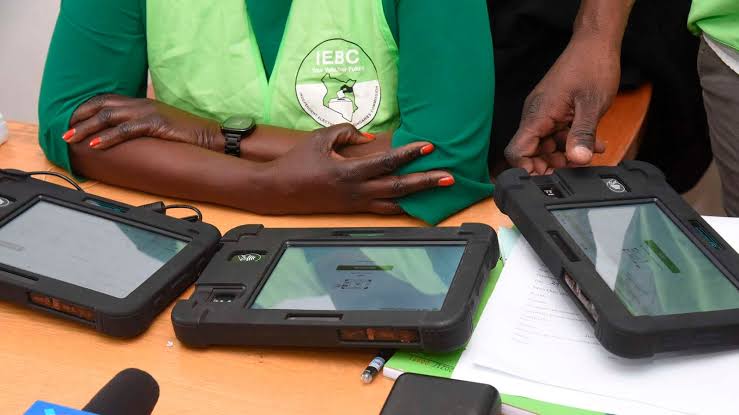
Kenya’s preparations for the 2027 General Election have hit a fresh procurement hurdle after the Public Procurement Administrative Review Board ordered the Independent Electoral and Boundaries Commission (IEBC) to rewrite and republish key parts of its KSh6.5 billion tender for a new election management system.
The decision does not cancel the procurement.
Instead, the Board has directed IEBC to correct sections of the tender that it found unclear and insufficiently objective, then issue a new version and give prospective bidders at least seven days to consider the changes before submitting their bids.
The ruling, issued on September 3, is the latest setback for one of the most closely watched procurements ahead of the 2027 polls.

And it comes at a sensitive time.
The technology being procured will form part of the infrastructure used to manage Kenya’s elections, meaning questions over how it is bought are almost as important as the technology itself.
What the procurement board found
The dispute centres on IEBC Tender No. IEBC/OIT/01/2026–2027 for the supply, installation, testing, commissioning, support and maintenance of the Integrated Elections Management System (IEMS), including related hardware and accessories.
Galadriel Investments Limited challenged the tender before the procurement review board in August.
After considering the challenge, the Board found that some requirements and evaluation criteria were not sufficiently clear, certain or objective.
Among the areas flagged were provisions dealing with hardware and technology ownership.
The concern is straightforward.
If bidders cannot clearly understand what the commission requires, or how their proposals will be assessed, it becomes harder to guarantee that every bidder is competing on equal terms.
The Board said the shortcomings raised concerns under the constitutional principles governing public procurement, including fairness, transparency, equality and competitiveness.
IEBC must start the affected part again
Rather than throw out the entire procurement, the Board ordered IEBC to review the disputed sections, make the necessary corrections and publish a compliant tender.
Potential bidders must then be allowed at least seven days to study the amendments and prepare their submissions.
The Board also gave IEBC permission to seek technical advice from the Public Procurement Regulatory Authority (PPRA) while making the changes.
There is an important distinction here.
The PPRA can assist IEBC on the procurement issues identified in the ruling, but the Board made clear that the electoral commission remains responsible for determining the technical specifications of the election system.
That keeps the technical design of the election system within IEBC’s mandate while allowing procurement officials to help resolve compliance questions.
It follows an earlier error over performance security
The latest ruling comes only days after IEBC admitted another problem in the same tender.
The commission had initially required the successful bidder to provide performance security equivalent to 20 per cent of the contract value.
The applicable procurement rules cap performance security at 10 per cent.
IEBC acknowledged the mistake during proceedings before the review board and said it had identified the error and was preparing an addendum to correct it. The commission maintained that the mistake did not invalidate the entire procurement.
The new ruling goes further.
It means IEBC must address not only the performance-security provision but also other aspects of the tender that the Board considered unclear or deficient.
No company has been awarded the contract
The procurement has attracted political controversy because of claims that the tender was written to favour a particular supplier.
Former Deputy President Rigathi Gachagua has alleged that the process was designed to benefit South Korean company Miru Systems.
He has specifically questioned the involvement of IEBC Chairperson Erastus Ethekon and Vice-Chairperson Fahima Abdallah.
Those are allegations by Gachagua and have not been established as fact.
IEBC has strongly rejected the claims.
The commission has said the procurement is open and competitive and that no company has been awarded the contract.
It has also denied that the tender was predetermined or tailored for a particular bidder.
The procurement board's latest decision should therefore not be read as a finding that Miru Systems, or any other company, was being favoured.
Its finding concerns the quality and clarity of the tender document.
Why the timing matters
The clock is now an important part of the story.
Kenya is less than a year from the 2027 General Election.
IEBC must procure, test and deploy election technology early enough for staff training, system testing and election-day preparations.
That means every delay matters.
At the same time, rushing the procurement simply because the election date is approaching could create an even bigger problem.
Election technology is not ordinary government equipment.
It sits at the centre of voter identification, election administration and the transmission and management of electoral information.
A system that is procured through a process seen as unclear or unfair could face questions long before voters cast their ballots.
That is why the Board's decision creates a delicate balance for IEBC.
The commission must move quickly.
But it must also get the procurement right.
Gachagua has questioned whether Kenya needs a new system
Gachagua has raised a second concern that goes beyond the tender itself.
He has argued that there may not be enough time before the 2027 election to introduce, test and establish confidence in an entirely new election management system.
He has instead called for improvements to the existing technology.
That position remains contested.
IEBC's decision to procure a new IEMS reflects its own assessment of what election infrastructure will be required for future polls.
The commission has defended the procurement and rejected claims that the process has already been decided in favour of a particular company.
The procurement board has not ordered IEBC to abandon the new system.
It has ordered the commission to make the tender clearer and more compliant.
The bigger issue is trust
For Kenya, this is ultimately about more than KSh6.5 billion.
Election technology has become one of the most sensitive parts of the country's electoral process.
The 2017 presidential election was annulled by the Supreme Court, which raised concerns about IEBC's handling of the electronic transmission and verification of results.
The 2022 election was also closely watched, with technology again playing a major role in public debate over the credibility of the results.
That history means procurement decisions involving election technology are unlikely to be treated as routine administrative matters.
Every specification will be scrutinised.
Every supplier will attract attention.
And every technical failure will be judged against the wider question of whether Kenyans can trust the system.
The procurement board's intervention therefore gives IEBC an opportunity as well as a problem.
A clearer tender can reduce uncertainty among bidders and strengthen the credibility of the eventual procurement.
But the commission now has to demonstrate that it can correct the weaknesses without allowing the process to drift dangerously close to the 2027 election.
The next document to watch
The immediate test will be the revised tender.
Once IEBC publishes it, bidders will be able to see whether the disputed requirements have been properly clarified and whether the evaluation process is easier to understand.
The Board has not stopped IEBC from pursuing the election technology.
It has effectively told the commission to fix the rules before choosing who wins the game.
That distinction matters.
There is no finding in the latest decision that the election technology contract has been rigged or that a particular supplier has already been selected.
But there is now an official procurement finding that parts of the tender were not clear enough.
With the 2027 election approaching, IEBC has little room for further mistakes.
The technology may be digital.
The consequences of getting its procurement wrong will be very real.
You may also like
Category: News · Related Topic: 2027 Elections
Related Video: Murkomen Says Kenya Is Safe: “Stop Creating a Crisis” | Political Goons & Security Under Scrutiny
About the Author
Maureen Onyango is a journalist passionate about storytelling, life coaching and spiritual lessons. She studied at the Kenya Institute of Management and enjoys telling stories that inform, inspire and empower communities.
 Facebook
 Twitter / X
 WhatsApp
 LinkedIn
 Telegram
 Reddit