
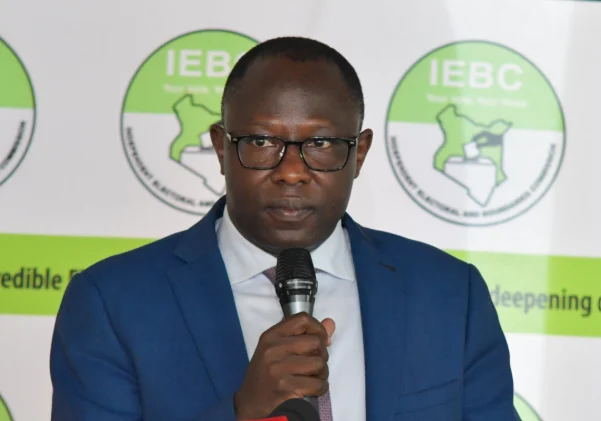
Kenya’s 2027 election is still nearly a year away, but a fight over the technology that will help run it is already testing public confidence in the country’s electoral referee.
The Independent Electoral and Boundaries Commission (IEBC) is facing questions over its procurement of a new Integrated Elections Management System (IEMS), a critical piece of infrastructure expected to support voter registration, voter identification and other election-management functions.
The dispute has moved beyond political accusations.
A Kenyan company, Galadirel Investment Limited, has formally challenged the procurement before the Public Procurement Administrative Review Board (PPARB), arguing that aspects of the tender could restrict competition and fall short of constitutional requirements for fair and transparent procurement.

At the same time, former Deputy President Rigathi Gachagua has accused the commission of designing the process to favour South Korean technology company Miru Systems.
The IEBC has rejected the allegations and insists that no company has been awarded the contract.
That distinction matters.
There is currently no public evidence that Miru Systems has won the tender. But the fact that a major election technology procurement is already being challenged — alongside an admission by the commission that one of its tender requirements was erroneous — has created a credibility problem the IEBC will need to address well before election day.
The tender at the centre of the dispute
The IEBC advertised the IEMS procurement on August 11, 2026, as part of its preparations for the August 10, 2027 General Election.
The tender, referenced as IEBC/OIT/01/2026-2027, covers the supply, delivery, installation, testing and commissioning of the IEMS, as well as associated hardware, equipment, support and maintenance.
The procurement has been reported at about KSh10 billion, rather than the KSh6.5 billion figure cited in some political commentary.
Bids were due by September 1, 2026, with bidders required to provide a KSh30 million tender security.
The system is particularly sensitive because election technology has become central to Kenya’s electoral process.
For voters, the technology is not simply about computers and kits. It affects how voters are registered and identified and how election information is managed.
Any doubts over the system can therefore quickly become doubts about the results themselves.
Why Galadirel went to the procurement board
The political controversy has been accompanied by a separate legal challenge.
Galadirel Investment Limited has asked the PPARB to intervene over what it describes as flaws in the tender.
Among its complaints are concerns about the technical specifications, the disclosure of the procurement value and requirements that the company argues could limit the number of firms capable of competing.
The company has also questioned a requirement that bidders demonstrate experience in election technology and have handled at least one election technology contract worth at least US$50 million between 2021 and 2025.
Galadirel argues that such requirements could favour companies with particular past experience, including Miru Systems.
The IEBC, however, says its requirements were informed by market research and the scale of the 2027 election.
The commission has maintained that no local company currently has the capacity to independently deliver a system of the size and complexity required for the national polls.
That is now a matter for the procurement process and, where applicable, the review board to determine — not something that can fairly be settled by political claims alone.
IEBC admits one tender error
The commission has also had to acknowledge an error in the procurement documents.
During the procurement challenge, IEBC admitted that it had initially set performance security at 20 per cent of the contract price, even though the applicable legal ceiling is 10 per cent.
The commission said the error would be corrected through an addendum.
That admission does not establish that the tender was designed to favour a particular company.
But it does explain why the procurement has attracted closer scrutiny.
For an electoral agency preparing to oversee a highly contested national election, even an administrative error in a major technology tender can become politically significant because public confidence depends not only on the final outcome but also on confidence in the process that produces it.
Gachagua turns procurement dispute into political warning
Gachagua has gone further than the procurement challenge.
The Democracy for Citizens Party leader has accused the IEBC of preparing to award the contract to Miru Systems before the bidding process is concluded.
He has called for the tender to be cancelled and for the existing system to be upgraded instead.
Gachagua argues that there is too little time to introduce a completely new election management system, migrate data and test the infrastructure before Kenyans vote.
“The time available is not sufficient to procure, migrate and adequately test a new election management system,” he has argued.
He has also alleged that some IEBC officials raised concerns about the procurement and that the tender specifications were prepared in a manner that could favour a particular supplier.
Those remain allegations. Gachagua has not publicly produced evidence establishing that the tender has already been awarded to Miru Systems.
The IEBC has strongly rejected the claims.
IEBC: no winner has been chosen
IEBC Chairperson Erastus Ethekon has said the procurement remains an open process and that no company, including Miru Systems, has been awarded the contract.
The commission has also rejected suggestions that its technical specifications were written around one supplier.
In response to Gachagua's claims, the IEBC said the tender documents had been made available through the commission and the Public Procurement Information Portal.
It has also dismissed suggestions that the procurement is intended to interfere with the Register of Voters.
The commission says the register remains under its control.
“The tender process is open and transparent,” the IEBC has said, while urging political actors not to politicise a procurement that is still subject to established procedures.
The National Assembly Speaker Moses Wetang'ula has similarly warned politicians against attempting to dictate how the electoral agency procures technology and other election materials.
His intervention highlights a difficult balance facing the country: the IEBC must be protected from political interference, but it must also be open enough to withstand legitimate public scrutiny.
The bigger problem is trust
The argument over the tender comes at a sensitive point in Kenya's electoral calendar.
The IEBC has formally set August 10, 2027 as the date for the General Election. Its election operations plan sets out a series of deadlines stretching into the months immediately before polling day.
That means decisions being made now will eventually be tested at the polling station.
Kenya's recent electoral history shows why technology alone cannot solve the trust problem.
A functioning election requires more than working voter-identification kits and a reliable results-management system. Voters also need confidence that procurement was fair, that the register is credible, that election officials are independent and that disputes will be handled impartially.
The IEBC's own preparations show the scale of the task. The commission is targeting at least 28.5 million registered voters for the 2027 election.
That is a vast logistical undertaking.
A system capable of handling such an election must therefore be tested long before polling day. Equally important, its procurement, audit trails, safeguards and contingency plans must be sufficiently clear to allow political parties, observers and the public to understand how it works.
A warning from the Kofi Annan Foundation
The technology dispute is unfolding against a wider warning about Kenya's electoral environment.
The Kofi Annan Foundation's 2026–2027 Electoral Vulnerability Index estimates an 84.1 per cent probability of some form of electoral violence around Kenya's 2027 election.
The figure should not be read as a prediction that Kenya will inevitably descend into nationwide violence.
The Foundation's assessment is a risk model designed to identify countries and electoral processes vulnerable to violence and to encourage early preventive action.
Importantly, Kenya's underlying vulnerability score is below the Sub-Saharan African regional baseline. The concern is that political tensions, institutional distrust and other pressures could still combine with election-related disputes to produce unrest.
That makes the current procurement dispute more consequential than a disagreement over a government contract.
If voters believe an election system was designed in secret, they may question results before they are even announced.
If parties believe the system was procured fairly, independently tested and subjected to credible scrutiny, the technology can instead become part of the solution.
The test for IEBC is transparency
The most important question now is not whether Gachagua's allegations will dominate the political conversation.
It is whether the IEBC can demonstrate, step by step, that the technology procurement can withstand scrutiny.
That means explaining the technical requirements, showing how market research informed them, publishing the relevant procurement information within the law, correcting errors openly and allowing legitimate challenges to run their course.
It also means resisting political pressure from all sides.
The procurement board will have to determine the merits of Galadirel's challenge. The IEBC will then have to demonstrate that whichever supplier ultimately emerges was selected through a lawful and competitive process.
For Kenya, that distinction could prove crucial.
The credibility of the 2027 election will not begin on August 10, 2027.
It is being built — or weakened — now.
And with the country already carrying the burden of electoral distrust, the IEBC has little room for secrecy, avoidable errors or explanations that arrive after suspicion has taken hold.
You may also like
Category: News · Related Topic: 2027 Elections
Related Video: Murkomen Says Kenya Is Safe: “Stop Creating a Crisis” | Political Goons & Security Under Scrutiny
Related Explainer: EXPLAINER: Why Kenya’s aviation workers are striking — and what travellers need to know
About the Author
Maureen Onyango is a journalist passionate about storytelling, life coaching and spiritual lessons. She studied at the Kenya Institute of Management and enjoys telling stories that inform, inspire and empower communities.
 Facebook
 Twitter / X
 WhatsApp
 LinkedIn
 Telegram
 Reddit